
Why Is My Fence Leaning After a Storm?
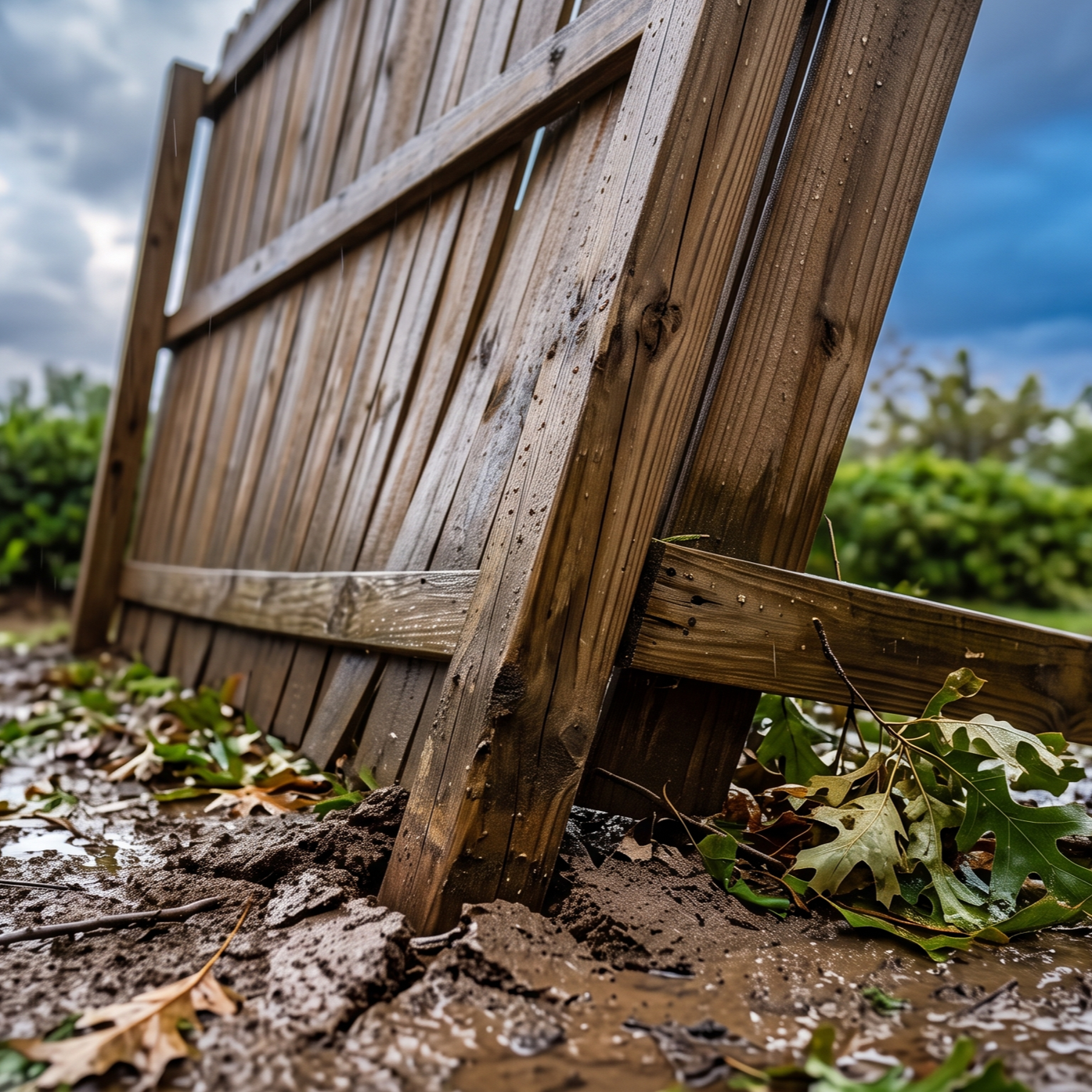
You walk the yard after a night of hard wind and rain, and the fence that stood straight yesterday is tilting like a row of dominoes caught mid-fall. A couple of posts lean toward the neighbor's yard, a panel gaps where the boards used to meet, and you are left wondering whether the whole thing is about to come down.
A storm rarely creates a leaning fence out of nothing. It exposes a weakness that was already there. The wind is the trigger, but the reason a post gives is almost always something happening down at the ground line, out of sight.
A Fence Panel Is a Sail
Start with the force. A solid fence panel is basically a sail. Wind does not slip through it; it pushes against the entire flat surface and transfers the load to the posts holding it up. The taller and more solid the fence, the bigger the sail and the harder the wind leans on it. A gust that a chain-link fence barely notices can put hundreds of pounds of sideways pressure on a privacy fence.
That forces all lands to one place: the post where it meets the soil. A healthy post set deep in firm ground shrugs it off. A post that has lost its grip, for any of the reasons below, gets levered over like a pry bar working a nail. So a lean is really the story of a post that could no longer hold its ground against a load it used to handle.
Why the Post Lost Its Grip
Several things weaken a post's hold, and a storm finds whichever one is present.
The most common problem in a humid climate is rot at ground level. Wood posts decay fastest right at the soil line, where they stay damp and have access to oxygen, the two things wood-eating fungi need. The post can look fine above ground, while the section just below the surface has softened to punk. When the wind pushes, the sound wood above pivots on the rotten wood below, and the fence leans.
Saturated soil is the storm's own contribution. Heavy rain turns firm dirt into mud, and mud grips a post far less than dry, packed soil. A post that would never budge in dry ground can loosen and tilt when the earth around it is soaked and soft, which is exactly the condition a storm delivers along with the wind.
The rest are installation shortcuts that the storm reveals: post holes dug too shallow, concrete footings too small or cracked and crumbled with age, and posts set without sufficient depth to reach below the zone where soil moves. None of these shows until a big enough load comes along to test them.
| What you notice | What likely failed | Worth checking |
|---|---|---|
| Post wobbles, wood soft at the base | Rot at the ground line | Probe the base with a screwdriver |
| Whole section leaned after heavy rain | Saturated soil loosened the footing | Whether it firms up as ground dries |
| Post pulls up easily, small footing | Shallow hole or undersized concrete | Depth and size of the footing |
| Concrete cracked around the post | Failed or aged footing | Condition of the concrete collar |
Why the Local Weather Makes It Worse
A fence here fights two things at once. The humidity keeps the base of every wood post damp for long stretches, feeding the rot that hollows out the ground line over the years. Then, high winds and storms deliver the load that finds those weakened posts. The combination is why so many leaning-fence calls cluster right after a storm: months of quiet decay, then one windy night that pushes the tired posts past their limit. It is also why the wood species and how deep the posts were set matter so much, because they decide how long a post resists that slow decay before a storm can topple it.
Straightening It the Right Way
A lasting fix depends on why it leaned. A post that only tilted because the soil was soaked may settle acceptably once the ground dries, and can sometimes be reset and re-braced. A post that rotted through at the base cannot be saved by pushing it upright, because the sound wood is gone where it counts, and it needs replacing. The same is true of a cracked or undersized footing. The honest repair starts by probing the base of each leaning post to sort the rotted from the merely loose, then resetting or replacing as needed and setting the new posts deep enough and in enough concrete to handle the next storm. Straightening the panel without fixing the post underneath just resets the clock until the next big wind.
Metal and Vinyl Fences Lean for the Same Reason, Differently
Most leaning-fence trouble is wood, but metal and vinyl fences tilt too, and the root cause is still the post's grip. Chain-link and ornamental metal posts do not rot, so when they lean it is almost always the footing letting go, a concrete collar that was too small, cracked, or set in soil that softened, or a post bent by impact. Vinyl fences use posts that sleeve over a wood or metal core or sit in concrete, and they lean when that footing fails, or the core inside gives, sometimes cracking the vinyl at the base. Whatever the material, the diagnosis lands in the same place: check the footing and how well the post is still anchored, because that is what actually holds any fence up.
Frequently Asked Questions
It depends on the post. If the post is sound and only loosened in soft, wet soil, it can often be reset and braced. If the post has rotted through at the ground line or its footing has failed, that post needs replacing, because straightening it does not restore the strength that decayed away. A quick probe at the base tells you which situation you have.
Because the weakest posts give first. The ones that leaned are usually the ones with the most rot, the shallowest holes, or the smallest footings, so the storm found them before the stronger posts. A fence is only as steady as its weakest posts, and the wind sorts them out for you.
It can be, especially if it is tall and leaning toward a walkway, a car, or a neighbor's property, because a partially failed fence can come down the rest of the way in the next wind. A heavy privacy fence has real mass. It is worth bracing or addressing before another storm finishes the job.
As a general rule, roughly a third of the post's above-ground height should be below ground, set in concrete, though taller, more solid fences require more embedment. The point is to get the post below the shifting, moisture-affected surface layer into firm ground. Posts set too shallow are the ones that lever over in a storm.
Sometimes, partially, if the only issue was saturated soil temporarily loosening its grip. But a post that has leaned has usually broken some of its bonds with the soil or the footing, so it rarely returns fully to plumb and stays weaker than before. It is better to assess and reset it than to hope the ground firms it back.
Beyond material, it comes down to how the posts are set: deep, in adequate concrete, with rot protection at the ground line, and a design that does not act as a total wind block in severe gusts. A well-set fence with sound posts survives storms that topple shallow, rotted, or under-built ones. The posts, not the panels, decide it.
The Panel Leans, but the Post Is the Story
A fence that tilts after a storm is telling you about its posts, not the wind. Rot at the ground line, soaked soil, shallow holes, and failed footings are the real reasons a post gives up its grip, and the storm just supplies the push. Probe the base of each leaning post to learn which failed, fix the post rather than just the panel, and set the replacements deep and solid so the next big wind finds nothing to topple.
If a storm left your fence leaning, have the posts checked before the next wind finishes the job. The Fayetteville Fence Company LLC serves Fayetteville, Hope Mills, Raeford, and the surrounding area. Call (910) 994-3634 for a free assessment.
