
How Deep Should Fence Posts Be Set? The One-Third Rule
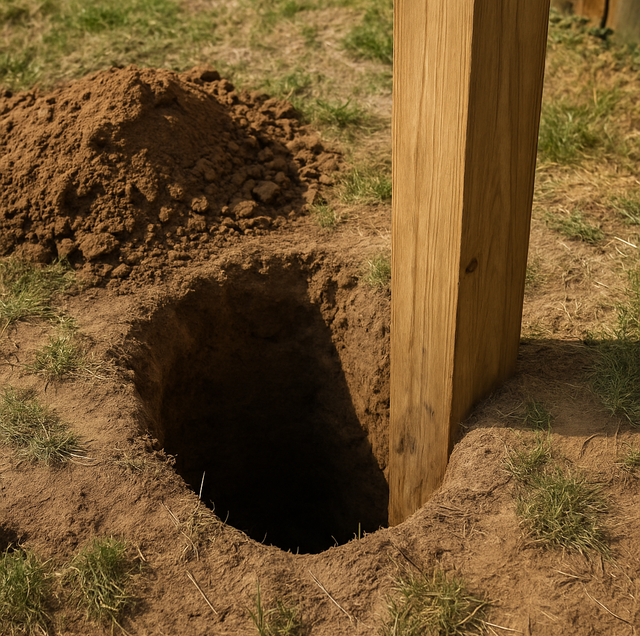
A fence is only as steady as the part you never see. The pickets and rails get the attention, but the buried third of each post does the real work of holding a hundred-plus feet of lumber upright against wind, wet ground, and years of freeze-and-thaw cycling. Set the posts too shallow, and the fence tells on you within a season or two: rails sag, a gate stops latching, and one post begins tipping like a loose tooth. Get the depth right, and the line stays true long enough that you forget it was ever a question.
Here is how post depth is figured, why it matters more than most people expect, and where a few extra inches earn their keep.
The One-Third Rule Most Installers Start From
The common rule of thumb is to bury about one-third of the post's total length, with a floor of roughly two feet, no matter what. A standard 6-foot privacy fence uses 8-foot posts, so you dig to about 30 inches deep and leave about 5.5 feet standing. That ratio puts enough post below grade for the surrounding soil to act as a fulcrum, resisting the horizontal push a tall fence catches from wind.
Depth is only half the hole. Width matters too, and the guideline is a hole roughly three times the post's width. A 4-by-4 that measures 3.5 inches across wants a hole around 9 to 12 inches in diameter. A hole that is deep but skinny does not give the concrete or compacted backfill enough shoulder to brace against, so the post can still rock.
Why a Few Inches of Depth Changes Everything
The load on a fence post is not straight down; it is sideways. Wind pressing on a solid privacy panel behaves like a sail, and that force tries to rotate the post around a pivot point near the ground surface. The deeper the post sits, the longer the buried lever arm resisting that rotation, which is why a shallow-set post leans while a deep-set one holds. It is also why the tallest, most wind-catching fences need the most depth, and a short, airy picket fence can get away with less.
Frost works in the opposite direction. When wet soil freezes, it expands, gripping a post and shoving it upward a little each cold snap, and come the thaw, the post does not always settle back. Over several winters, this frost heave can jack a post out of plumb or lift it enough to bind a gate. Setting the base of the post below the local frost line anchors the bottom in ground that never freezes, so the heaving soil above cannot get a grip.
Reading the Frost Line Where You Live
The frost line is the depth to which the ground reliably freezes in your area, and it varies enormously by climate. In the coldest regions, it can run 40 to 48 inches, which forces posts far deeper than the one-third rule alone would suggest. In mild-winter regions, the frost line is shallow, often only a few inches to under a foot, so a standard 24-to-30-inch hole already clears it with room to spare.
That does not let a warm-climate installer off the hook. In a humid region, the enemy is water, not ice: heavy clay holds moisture against the buried post for weeks after a storm, and constantly damp ground both accelerates rot and stays soft enough to let a poorly set post work loose. The logic flips. In cold-winter regions, you dig deep to beat the freeze; in warm, wet climates, you focus on drainage and firm bearing so the post is not sitting in saturated clay year-round.
Gravel, Concrete, or Tamped Earth at the Base
How you fill the hole is a separate decision from how deep you dig it, and each method trades off differently.
A concrete collar gives the most rigid hold and is standard for anything that carries a load. The trick is to keep it from becoming a water trap: first, pour a few inches of gravel into the bottom so the post does not rest on concrete, and crown the top so rainwater runs off rather than pooling at the base.
A gravel-set post, packed with compacted crushed stone or 3/8-inch pea gravel, drains freely and lets a wood post dry out between rains. Many installers favor it for line posts in wet soil because drainage can add years to a wood post's life compared to moisture-holding concrete. The trade-off is a slightly less rigid hold, so it suits line posts more than high-stress ones.
Tamped earth, backfilled with the excavated soil compacted in layers, is the oldest method. It works for low, light fences in firm ground, but offers the least resistance to leaning and is a poor choice in loose or sandy soil. Whatever the fill, a 3-inch bed of gravel at the very bottom of the hole is worth adding, since it lets groundwater drain away from the post's end grain rather than wicking up into it.
Where Corner and Gate Posts Need More
Not every post carries the same job. Line posts share the load with neighbors on both sides, but corner, end, and gate posts anchor the whole system and take an uneven pull. Corner and end posts hold tension pulling one direction with nothing pulling back, so they go deeper and wider than line posts, often a 12-inch-diameter hole on fences 6 feet and taller. Gate posts have it hardest: they carry the dead weight of a swinging gate plus the repeated jolt of it being opened, slammed, and leaned on. Setting gate and corner posts several inches deeper than line posts, always in concrete rather than gravel or earth, keeps them from tilting and throwing the gate out of square.
What Post Depth Comes Down To
Depth is the cheapest insurance on a fence, and it is the one thing you cannot fix later without pulling the post and starting over. The buried third braces against wind that wants to push the fence flat, resists the freeze-thaw and wet-dry cycling that tries to lift and loosen it, and keeps gate and corner posts square long after the hardware would otherwise sag. When a fence stays arrow-straight for a decade while a neighbor's leans, the difference almost always starts at the bottom of the hole.
Frequently Asked Questions
A 6-foot privacy fence usually calls for an 8-foot post set about 28 to 30 inches deep, because the solid panel catches wind like a sail and needs the extra buried length to resist tipping. A 4-foot fence, especially an open-picket or split-rail style that lets wind pass through, can often be set closer to 24 inches.
Yes, and the usual practice is to dig them 4 to 8 inches deeper than line posts and use a wider hole, often 12 inches across on taller fences. A gate post also carries a load line posts never see: every time the gate swings, its weight torques the hinge post outward. Many installers upsize a gate post to a 6-by-6 or add a diagonal brace to the adjacent post to spread that repeated stress.
Gravel-setting often wins in heavy clay because the compacted stone lets water drain away instead of trapping it against the wood, which can add several years of life before rot sets in. Concrete gives a firmer hold and is the right call for gate and corner posts, but only if you crown the top so water sheds off. A hybrid many crews use is gravel around the buried post with just a small concrete cap at grade for stability.
Even where the frost line is only a few inches deep, the same wet ground that freezes shallowly stays saturated for weeks after rain, and soft, water-logged clay grips a post poorly and lets it wander. In warm, humid areas, the practical target shifts from beating the frost to beating the moisture: firm bearing at the bottom of the hole and a gravel drainage bed matter more than raw depth. In hard-freeze climates, missing the frost line by even a couple of inches invites annual heave.
A buried post works as a lever with the soil near the surface as the pivot, and the length of the post below it resists the turn. Doubling the effective buried depth roughly quadruples the post's resistance to overturning, which is why an extra 6 inches in the ground does far more against wind than an extra 6 inches of concrete width.
Wood posts most often rot right at the concrete line, the spot at grade where the wood stays alternately wet and dry, and oxygen is plentiful, rather than deep in the hole. Crowning the concrete so water runs off, keeping mulch and soil from piling against the post, and using a ground-contact-rated pressure-treated post all slow it. Setting the post on a gravel bed rather than pouring concrete directly under it also keeps the vulnerable end grain from sitting in trapped water.
Schedule a free on-site consultation for a fence built on properly set posts — AR Fence serves Fayetteville, Hope Mills, Raeford. Call (910) 994-3634.
