
How to Choose the Right Fence: 7 Questions Most Homeowners Skip
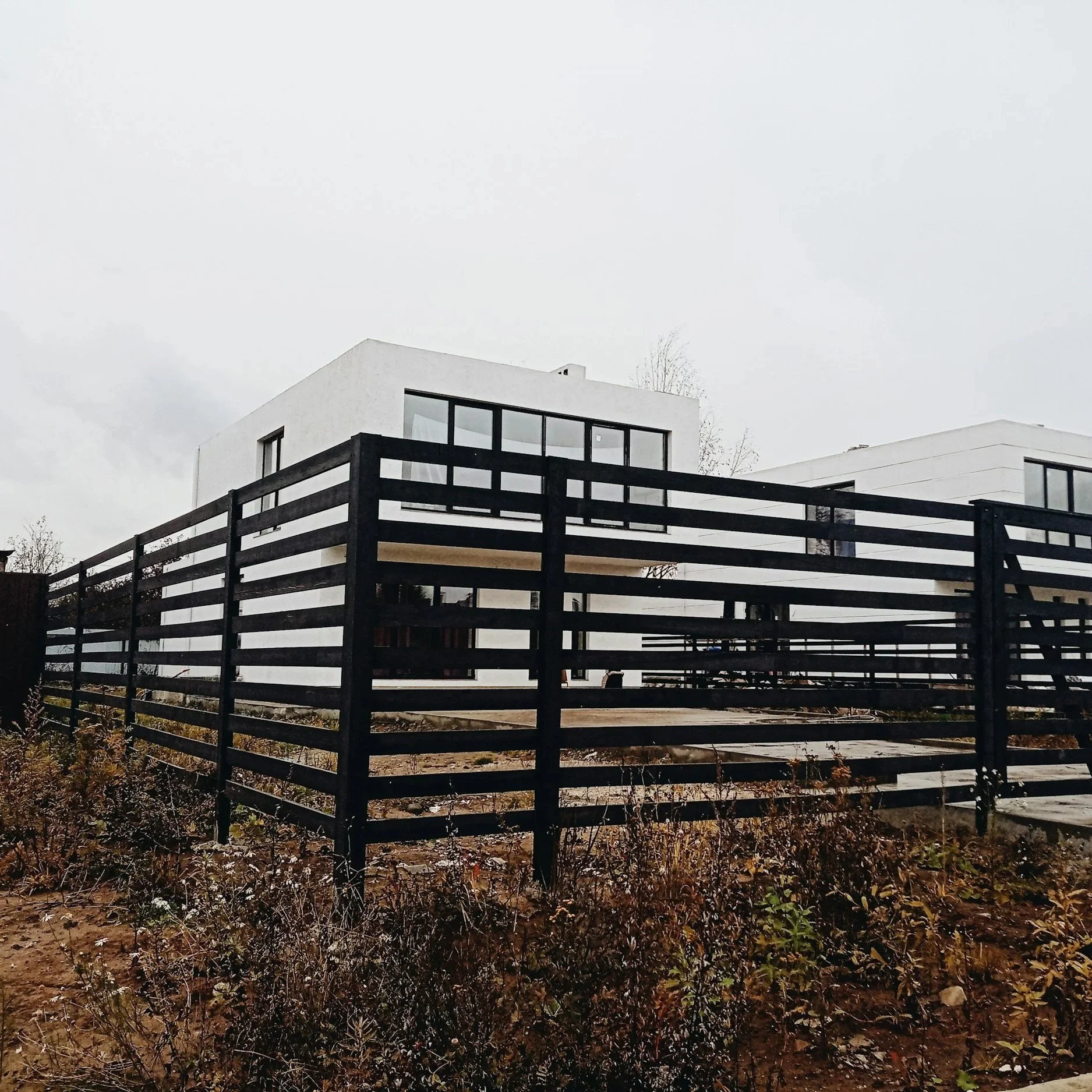
Modern horizontal black fence surrounding contemporary home, highlighting important planning considerations when choosing the right residential fencing solution.
If you have been thinking about a fence and feeling overwhelmed by the material choices, you are starting in the wrong place. Before you pick wood, vinyl, or aluminum, seven questions determine which fence is actually right for your situation. Most homeowners skip these and end up with the wrong fence: too tall, too short, wrong material, wrong placement, or fine for the first three years and a regret by year ten. What follows is the conversation a good fence contractor would have with the homeowner before quoting anything.
The Question Most Homeowners Skip First
Most fence projects start at the wrong end. People walk into the conversation already knowing they want a “vinyl privacy fence” or a “cedar wood fence.” They have picked the answer before they have asked the question. Then they end up with the wrong fence for what they actually need, or paying for features that do not matter for their situation.
The right place to start is not with material. It is what the fence is supposed to do for you. The seven questions below, in order, lead to a fence choice you will not regret. Some take a few seconds to answer. Some require pulling out the HOA covenants and reading them. Work through all seven before you collect a single quote.
Question 1 — What Is the Real Purpose of This Fence?
Most fences serve one of these jobs: privacy, containment (kids or pets), pool safety, property line definition, security, curb appeal, wind or noise reduction, or keeping wildlife out. Many fences serve more than one. The trouble is, each purpose pushes toward different materials and styles, and a fence built for the wrong job costs more and works less well.
A privacy fence and a curb-appeal fence are different products. Privacy needs height and solid panels. Curb appeal often means lower height, ornamental design, and visibility from the street. Try to do both with a single 6-foot solid wood fence, and you usually get neither.
A pet-containment fence depends on the pet. A Husky needs height and dig-prevention. A Beagle needs gap-free panels at the bottom. A small terrier might need both. Generic 4-foot picket fences do not contain Huskies; they are a starting point for a Beagle owner.
A pool fence is its own category. NC code requires specific height, self-closing self-latching gates, and gap dimensions; you do not pick a pool fence based on style and then check code. You pick it based on code, then look at the style options inside what is compliant. Pool fencing is non-negotiable in its specs.
Write down what your fence actually needs to do. If the list has three items, prioritize. The fence that does all three at 80% effectiveness usually beats the fence that does one at 100%.
Question 2 — How Long Do You Plan to Stay in This Home?
This question quietly decides whether to spend less upfront or less in total over time. Most homeowners answer it implicitly by buying the fence they can afford right now, then regret it 5 or 10 years later when the math plays out.
Three time horizons frame the decision differently.
If you are staying 5 to 7 years, spend less upfront. A pressure-treated pine fence at $4,000 to $5,000 will last the duration of your ownership without a problem. The next owner gets a fence that is still serviceable. Buying a $7,000 cedar fence for that timeline pays for years you will not see.
For a stay of 10 to 15 years, the math gets interesting. Pressure-treated pine usually needs replacement around year 12. Buying pine and staying 13 years means either replacing the fence near the end of the stay or selling with a fence that is about to fail. Cedar at a 20-plus year average means one installation for the whole period.
If you are staying 20 or more years, cedar, vinyl, or aluminum almost always wins on total cost. Pine would need replacement at least once during your stay, possibly twice. The upfront premium on the longer-lasting materials pays back during your tenure.
This is not hypothetical for The Fayetteville Fence Company LLC customers. Second-generation pine fences are common in the area for homeowners whose first pine fence failed in year 12, and those homeowners are now paying for a second installation that would not have happened if they had bought cedar 15 years ago.
Question 3 — What Does Your HOA Actually Allow?
If your neighborhood has an HOA, this question sometimes makes everything else moot. Many homeowners get attached to a fence type, then have to start over when the HOA rejects their application. Read the covenants before you fall in love with a specific fence.
Common HOA restrictions include allowed materials (some neighborhoods only permit wood, some only vinyl), specific colors (often natural tones or approved finishes), height limits tighter than city code, and prohibited styles (no chain link, no barbed wire, sometimes no ornamental aluminum). Some HOAs also require neighbor sign-off if the fence sits on a shared property line.
Pull the covenants from your HOA portal or ask a board member. The relevant section is usually called “fences” or “exterior modifications.” It often runs only a page or two but determines what you can install.
If the HOA’s allowed materials do not include the homeowner’s preference, the options are: change your preference, request a variance (rarely granted), or accept the constraint. Variance applications can take months and usually get denied, so plan around the existing rules.
Question 4 — Does Your Property Have an Exposure Problem?
Exposure is the amount of much wind, sun, water, or visual exposure the fence faces. It is the question most homeowners do not think about until their fence fails for a reason their neighbor’s fence did not.
Wind exposure matters most in this region. Cape Fear country sees hurricanes and tropical storms most years; sustained winds of 50 to 75 mph are realistic for any installed fence. Solid privacy panels catch the wind like sails. Open designs (aluminum, chain link, shadowbox wood) let wind pass through. If your property is on a corner lot, near open fields, or facing into the prevailing wind, the wind question dominates the material question. A solid 6-foot wood privacy fence on an exposed corner lot is asking for trouble; the same fence in shadowbox style or aluminum solves the problem.
Sun exposure matters for material durability. UV degrades wood color, vinyl finish, and some sealants over the years. A fence facing west or south bakes in the afternoon sun; a fence behind a row of mature trees does not. UV-resistant materials and finishes pay for themselves on highly exposed runs and do not matter much in shade.
Water exposure compounds rot. A fence in a yard that drains poorly, sits in a low spot, or has irrigation hitting it daily will fail faster than a fence in a dry spot. Concrete footings handle saturated soil; sealed wood handles surface moisture. If your yard has a drainage problem, the fence is going to feel it within five years.
Visual exposure is about who sees the fence. Front-yard fences and corner-lot fences are visible from streets and neighboring properties. Backyard fences hidden by landscaping are not. Visual exposure changes how much you should care about appearance and finish quality versus pure function.
In Hope Mills, NC, and Fayetteville, NC, the combination of hurricane exposure, sandy soil, and humid summers means the exposure question is almost never trivial. Do not skip it.
Question 5 — What Is Your 10-Year Budget, Not Your 1-Year Budget?
The cheapest fence at year one is rarely the cheapest at year ten. This is the question that does the most damage when homeowners skip it.
Pressure-treated pine costs $15 to $25 per linear foot installed (industry range), or roughly $3,000 to $5,000 for a 200-foot residential fence. Cedar costs $25 to $40 per linear foot, or $5,000 to $8,000. Aluminum costs $30 to $50 per linear foot, or $6,000 to $10,000. The pine looks cheapest at install. The pine is not the cheapest over 10 years.
Run the numbers honestly. Pine averages 12 years in Cape Fear humidity. Installing pine in year 0 and staying 13 years means replacing it around year 12 (a second installation at $3,000 to $5,000), bringing the 10-year cost to $6,000 to $10,000. Cedar at a 22-year average runs $5,000 to $8,000 over the same period without replacement. Aluminum at 25-plus year lifespan runs $6,000 to $10,000 with no replacement and almost zero maintenance.
The pine homeowner pays similar money to the cedar or aluminum homeowner over 10 to 15 years, but with a second installation in the middle, increased disruption to the yard, and a brief stretch of having no fence between projects.
Now run it differently. If you have $5,000 to spend right now, what is the cheapest 10-year cost? You can buy a $5,000 pine fence and replace it once, for a total of $9,000 to $10,000. You can buy a $5,000 cedar fence (slightly less than mid-range) and pay nothing more for 10 years. You cannot buy aluminum for $5,000 unless the run is short. The right answer depends on your length of stay and the specifics of your property, but “what fits in my budget today” is rarely the same answer as “what costs least over the time I’ll own it.”
This is the section where The Fayetteville Fence Company LLC is not always the cheapest quote. The Fayetteville Fence Company LLC installations use galvanized hardware, deeper post-setting, and concrete footings on every project, which prices higher upfront. Skipping those saves $500 to $1,000 at installation but typically costs $2,000 to $4,000 in repairs or replacement over a 10-year window. Cheap and lasts do not go together for fences.
Question 6 — What Is Underneath Your Yard?
Soil and site conditions affect installation cost, fence longevity, and material choice. Most homeowners never think about soil, but the same fence material installed in different soil can have very different lifespans.
Sandhills soil drains fast in normal conditions, but does not grip posts. Concrete footings are required for any fence built to last in this region; setting posts in soil alone fails within a few years, especially after a wet season. Heavy clay soil has the opposite problem: it holds water, creates expansion-contraction stress on posts, and can heave fences after winter freeze cycles (less of an issue here than further north).
Slopes complicate everything. Stepped fences (panels offset to match slope changes) require more materials and labor than fences on flat ground. Some materials handle slopes better than others; vinyl panels, in particular, do not slope well, while wood and aluminum can be customized.
Underground utilities are an obstacle. Gas lines, electrical, irrigation, and septic systems limit where posts can go. NC requires Call Before You Dig (811) for any fence installation with post holes, and most contractors handle that automatically. Mark your sprinkler lines yourself if they are not on file.
Existing trees affect both placement and long-term integrity. A fence built with mature tree roots in the path is going to lift over time as the roots grow. A 10-minute walk-through with a fence contractor catches most of these.
Question 7 — Who Else Lives in This Yard?
Other people and animals using the yard change what the fence needs to do.
Kids change height and design considerations. Visibility through the fence (so a parent can see kids in the yard from the house) matters more than privacy in some cases. Wide horizontal rails on tall fences become climbing aids; tighter pickets reduce that risk for kids. Most fencing codes set minimum heights for safety; verify the requirement for your jurisdiction.
Dogs change everything based on breed. Large or athletic dogs need height (4 feet contains some breeds, 6 feet contains most). Diggers need a buried bottom rail or a concrete footing along the bottom. Climbers (Huskies are the famous example) need smooth surfaces and inward-curving tops. Small dogs need gap-free panels at the bottom; a 4-inch gap that lets a Lab through unbothered will release a Chihuahua.
A pool changes the question entirely. NC pool code requires specific height, self-closing self-latching gates, and gap dimensions. A pool fence is not really an aesthetic choice; it is a code-compliance installation with style options inside the requirements.
Outdoor recreation use (kids playing, dogs running, gardens with frequent access) changes gate placement and count. A fence with one gate is fine for a dog-walking owner; a yard with three different access patterns probably needs two or three gates. Gate count affects cost meaningfully, so plan it before quoting.
Livestock or rural property is a different fence category entirely. If you have chickens, goats, or larger animals, the fence types and post-setting depths shift toward agricultural standards.
How These Answers Add Up
A worked example. A homeowner in a Fayetteville, NC, neighborhood with an active HOA, planning to stay 15-plus years, with two kids and a Lab, on a corner lot with a pool. Sandhills soil. The seven answers point them toward:
A pool-code-compliant fence is the starting requirement. The HOA narrows the material to vinyl or wood, depending on the covenants. The back yard runs 6-foot privacy panels with a separate code-compliant pool fence inside that perimeter. The installation calls for concrete footings, deep posts, and galvanized hardware to handle wind exposure. Material choice biases toward 20-year longevity because the homeowner is staying long-term.
That combination usually points toward shadowbox cedar or vinyl for the perimeter (HOA permitting) with a code-compliant pool fence inside. Maybe $9,000 to $14,000 total for the project. The same property with no pool, no HOA, and a 5-year time horizon would point toward a pressure-treated pine fence at $4,000 to $5,000. Totally different conversation, totally different right answer.
The takeaway: there is not one right fence material. There is the right fence for the seven answers. A good contractor asks the questions before quoting; if yours is not asking, you are getting a generic fence, not one that fits the property’s situation.
Frequently Asked Questions
Match the fence to your stay. If you are in a starter home, you will sell in 5 years, a 10-year fence is plenty. If you are staying 20 years, buy something that will not need replacement on your watch. Cedar, vinyl, and aluminum are 20-plus year materials in Cape Fear humidity; pressure-treated pine is 10 to 15.
Pressure-treated pine, usually. It is the cheapest residential wood option, lasts 10 to 15 years, and the next owner gets a fence that is still working when they move in. Spending more on cedar or vinyl for a 5-year stay is paying for years you will not be there.
Pull your HOA covenants from the neighborhood portal or ask a board member. Look for the section on fences or exterior modifications. If the section is unclear, email the HOA management company directly and ask for written clarification before applying.
Depends on the dogs and the kids. For most families, a 6-foot solid privacy fence (wood, vinyl, or shadowbox style) handles both. For climbers or jumpers (Huskies, athletic mixed breeds), add height and smooth surfaces. For small dogs, make sure the bottom is gap-free. For visibility into the yard from the house, consider a partially open style.
Prioritize whichever the math favors for your length of stay. Under 7 years, upfront cost wins; over 15 years, longevity almost always wins. Between 7 and 15 years, run the numbers both ways before deciding. Ignoring the timeline question is the most expensive thing most homeowners do.
The right fence comes from the answers, not from a contractor’s preference or a neighbor’s recommendation. Work through these questions before you collect quotes; the conversation you will have with installers will be sharper, the quotes will be more comparable, and you will end up with a fence that fits the property instead of fitting a generic spec sheet.
Worked through the 7 questions and want to talk to a contractor who’ll listen to your answers? The Fayetteville Fence Company LLC provides free, no-pressure estimates in Fayetteville and Hope Mills. Call (910) 994-3634 to schedule.
