
Why Do Fence Gates Sag and Stop Latching? The 6 Real Causes
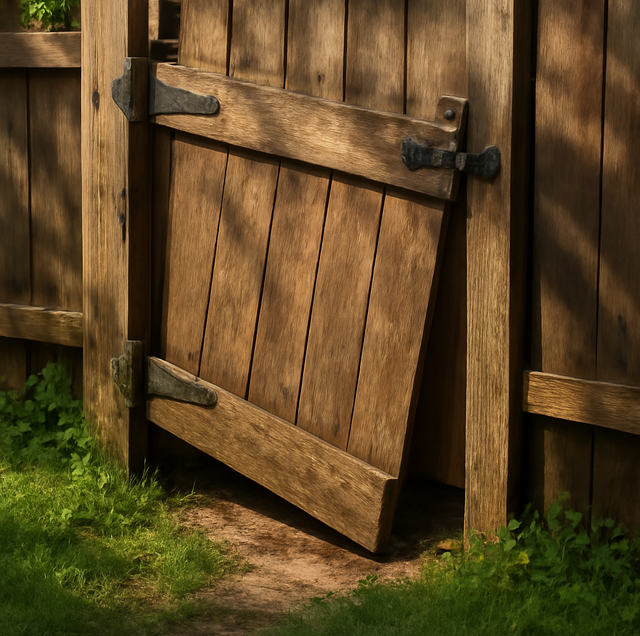
Quick Answer: Gates sag because they hang off one side only. Gravity pulls the far corner down, racking the frame into a leaning parallelogram, so the latch side drops out of line with the catch. The fix is to find whether the hinge post is tilting (a footing problem) or the frame itself has gone out of square (a bracing or hinge problem), then correct that specific cause before touching the latch.
You walk up to the gate, swing it toward the post, and the latch tongue lands a finger's width below the catch. Maybe the bottom corner drags a shallow arc into the dirt. Maybe you have started lifting the gate with one hand while you flip the latch with the other. The gate closed fine last year. Now it fights you every time.
A sagging gate is almost never a latch that "went bad." The latch is just the part you notice when there's a problem. What has actually happened is that the gate's rectangular frame has lost its square shape and drooped on the latch side, so the whole assembly no longer lines up with the hardware it used to meet. Understanding why that happens and where tells you whether you need to dig up a post or simply tighten a cable.
The Mechanism: A Gate Is a Lever Fighting Gravity
Picture a shelf bracket screwed to a wall, holding nothing but its own weight at the far end. Now imagine that bracket is four feet long and made of wood. Every hour of every day, gravity pulls down on the far end, and the only thing resisting it is the corner where the bracket meets the wall. That is your gate. It hangs entirely off one vertical edge, the hinge side, and the latch side is the unsupported far end of the lever.
A gate frame is built as a rectangle: two verticals, two horizontals, four corners. Rectangles are not naturally rigid. Push down on one corner and a plain rectangle folds into a parallelogram, the way a cardboard box collapses when you press its top edge sideways. This folding is called racking. On a gate, gravity does the pushing, constantly, at the latch-side corners. Left unresisted, the frame slowly leans, the latch corner sinks, and the top rail tips away from the latch post. That drop is the sag you see.
Two things are supposed to stop this. First, the hinge post has to stay perfectly vertical, because the whole gate references its position off that post. Second, the frame itself must be prevented from racking, which is the job of a diagonal brace or cable. When either of those fails, the gate droops. Everything below is a version of one of those two failures.
Why It Happens: The Common Causes
A leaning or undersized hinge post- This is the failure people miss most, because the gate looks like the problem when the post is the culprit. A gate's weight is a constant sideways and downward pull on the post it hangs from. If that post was set shallow, or in loose soil, or without enough concrete around its base, it slowly tips toward the gate. As the post leans, it carries the entire gate with it, and the latch side drops even though the gate frame is still perfectly square. Heavier and wider gates lean their posts faster.
No anti-sag brace or cable, or a loose one- If the frame has no diagonal member resisting the rack, or the one it has has gone slack, nothing holds the rectangle square. A wood brace can crack, split at its fastening, or pull loose. A steel cable can stretch, and its turnbuckle can back off over seasons of vibration. A loose diagonal is nearly the same as no diagonal.
Loose or worn hinges and pulling screws- Hinges take the full shear load of a hanging gate. Screws driven into end grain or into softened wood gradually work loose and back out. Once a hinge leaf shifts even a little, the top of the gate drops, and a small drop at the hinge multiplies into a large drop at the far latch corner.
A heavy or wide gate with too little support- A wide gate is unforgiving. Every extra foot of gate width and every extra pound of infill multiply the force trying to rack the frame and tip the post because the load sits farther from the hinge. A gate that would hold its shape at three feet wide can sag badly at six if it were built with the same lightweight hardware.
Wood swelling, rot, or a warped frame- Wet wood swells, dries, and warps, and the frame twists out of true. Rot at a corner joint destroys the very connection that keeps the rectangle rigid. A warped rail no longer pulls square, even with a tight brace.
Rusting hardware- Corroded hinges seize and wear at their pivots, corroded fasteners lose their grip, and a rusted cable loses strength. Rust is slow, but it undermines every part that was holding the gate in shape.
Diagnosis: Post Problem or Frame Problem?
Before you fix anything, you have to answer one question, because the two failure families need opposite repairs. Hold a level against the hinge post, the one the gate swings from.
If the post itself is tilting off vertical, the footing has failed. The gate may still be a perfect rectangle, but the whole thing has rotated with the leaning post, dropping the latch side. Fixing the frame here would be a waste of work; the post is the issue.
If the hinge post reads plumb and true, but the gate frame has visibly drooped so its latch-side corner sits low and the frame reads as a leaning parallelogram rather than a rectangle, the post is fine, and the gate itself has racked. That points you at the brace, the hinges, or the joints, not the footing.
A quick second check: sight along the top rail of the gate toward the latch post. If the rail tips down toward the latch, that is racking at the frame or a dropping hinge. If the entire gate, rail, and all, is leaning as a unit, look back at the post.
The Fixes, Matched to the Cause
Reset or reinforce a leaning hinge post- A hinge post carrying a gate needs a proper concrete footing, set below the frost-affected zone for your ground and wide enough to resist the constant tipping load. If the existing post is undersized or was never set in concrete, the durable fix is to reset it in an adequate footing, or replace it with a heavier post. Tamping more dirt around a leaning post rarely holds, because the same load that tipped it will tip it again.
Add or tighten the anti-sag diagonal, in the correct direction- Direction matters here, and getting it wrong does nothing. A rigid wood compression brace must run from the top hinge corner down to the bottom latch corner, so it pushes up against the sagging latch side. A steel anti-sag cable with a turnbuckle runs the opposite way, from the top latch corner down to the bottom hinge corner, and you tighten the turnbuckle to pull the gate back into square. One works in compression, the other in tension; installed backward, a wood brace hangs useless, and a cable simply helps the gate collapse.
Upgrade the hinges- If the hinges are undersized, worn, or their screws have pulled, move up to heavy-duty hinges with longer, larger fasteners driven into sound wood, ideally through-bolted on a heavy gate. Fresh hardware in soft or rotted wood will not hold, so address rot at the same time.
Rebuild a rotted or warped frame- When the wood has failed, no brace can pull a compromised joint square. The honest fix is to rebuild the affected members with sound, properly treated material and solid corner joinery, then brace the new frame correctly.
Adjust the latch, but last- Moving the latch or its strike plate can recover a little alignment, and it is worth doing as the final step. It is never the fix on its own. If the gate is still sagging, it will keep dropping and outrun any latch adjustment you make. Bring the post or the frame back to square first; then set the latch to meet a gate that will actually stay put.
A note on climate. A humid, storm-prone setting works both ends of this problem: soaking rains keep wood swelling, drying, and rotting, while damp air corrodes hinges and cables. But the same gate in a bone-dry climate is not spared. There, hardware still fatigues, footings still shift, and a wide gate still racks under its own weight and width. Weather accelerates the decay; it does not create the underlying lever-and-rack physics that make gates sag everywhere.
Frequently Asked Questions
Check the hinge post with a level first, but you can also quantify how far the frame has racked. Measure corner to corner along both diagonals of the gate frame. If the two diagonals differ by more than about a quarter inch, the frame has racked out of square, and the fix lives in the bracing or the joints. If the diagonals are nearly equal but the whole gate still leans, the frame is fine, and a tilting post is what dropped the latch side. That single measurement separates a frame problem from a post that is simply leaning.
It is the diagonal member that keeps the gate frame from folding into a parallelogram. A wood compression brace runs from the top hinge corner down to the bottom latch corner. A steel anti-sag cable, usually about 1/8 to 3/16 inch with a turnbuckle to tension it, runs the opposite way, from the top latch corner to the bottom hinge corner. Whichever you use, the brace or cable end has to seat into the actual corner of the frame rather than land against the middle of a rail. Anchored mid-rail, it cannot resist the rack, because the folding force lives at the corners.
Because a gate hangs entirely off that one post, its weight becomes a constant sideways pull rather than a straight-down load. A rough rule is that a hinge post should be larger and set deeper than a line post, often about a third of its length in the ground and in a wider concrete footing, precisely because it carries a swinging cantilever load that the line posts never see. A hinge post sized like an ordinary line post is undersized for that duty and slowly tips toward the gate. As it tips, the latch side drops with it, so the gate stops latching even though the frame is still true.
Moving the latch or the strike plate can buy a little room and make the gate catch for a while. The latch style matters here too: a spring-loaded or gravity latch tolerates a bit more sag than a rigid strike before it stops catching, so switching to that style buys some extra margin. But it is still a stopgap. If the gate keeps sagging, it will outrun any latch, so the tweak only holds after the post or frame has been brought back square.
A fence panel is held by a post at each end, so its weight is shared between two supports and it does not swing. A gate hangs from one side only and moves every time it opens, so the same weight a panel would split between two posts is instead carried and racked entirely at the gate's single hinge side. That concentrated, one-sided load is why the gate droops while the neighboring panels stay straight.
Yes. Extra width and weight put far more strain on both the hinge post and the frame, so a heavy or wide gate needs a bigger, deeper-set hinge post, heavy-duty hinges, and a properly sized brace or cable. Very large gates often need help carrying the latch side as well, such as a small wheel that rolls on the ground or a drop rod that pins the far corner when the gate is closed.
Have us diagnose the post or the frame and set your gate square again — so it swings free and latches on the first try. AR Fence serves Fayetteville, Hope Mills, Raeford. Call (910) 994-3634.
