
Vinyl Fence Cracking or Discoloring? The Real Causes
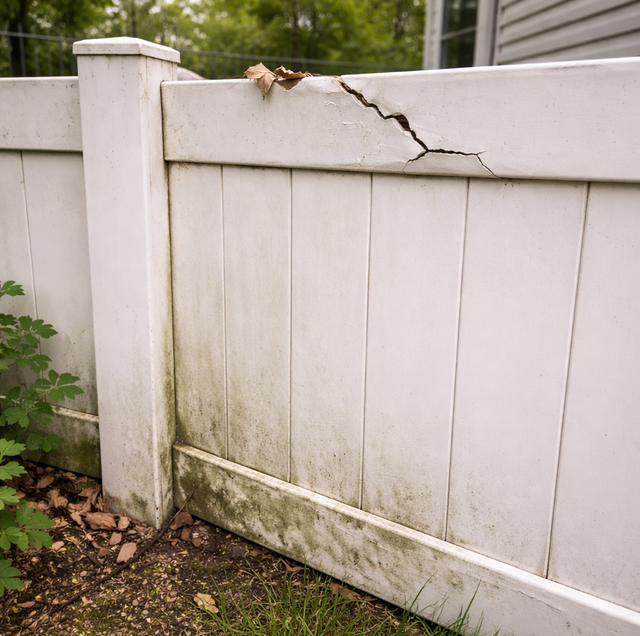
Quick Answer: Vinyl fencing cracks mostly from impact, brittleness in hard freezes, thin low-grade panels, and posts that shift with the ground. It discolors from UV exposure when the vinyl lacks titanium-dioxide inhibitors, from surface oxidation, and from mildew or lawn-chemical staining. The good news is that most discoloration is a surface issue you can clean, while cracking usually points to the material or the install.
Vinyl fencing gets sold as the panel you install once and forget. For the most part, that holds up, but not every vinyl fence is built the same, and not every problem you see means the fence is failing. A hairline crack near a post and a chalky film across a rail come from completely different causes, and treating them the same way wastes your time. Knowing what is actually happening in the material helps you decide whether you are looking at a cleaning job, a single-panel swap, or a sign that the fence was underbuilt from the start.
What Vinyl Fencing Is Actually Made Of
Vinyl fence is polyvinyl chloride, the same PVC family used in pipe and window trim. On its own, rigid PVC is a hard, somewhat brittle plastic, so manufacturers blend in impact modifiers, stabilizers, and pigment to make it behave outdoors. Two additives matter most for how a fence ages: titanium dioxide, a white UV-blocking pigment mixed into the compound, and the way the panel is built up in layers. Better panels are co-extruded, meaning a tougher weather-facing outer layer, often an acrylic or ASA cap, is bonded over the core in one pass. That cap carries most of the UV protection and gloss, while the core provides the bulk.
Cheaper panels skip the cap layer and thin out the walls to save material. A rail that looks identical on the shelf can have noticeably thinner walls than a premium one, and that single difference shows up years later as brittleness, sagging, and fading. So when a fence cracks or yellows early, the answer often traces back to what went into the compound long before it reached your yard.
Why Vinyl Fencing Cracks
Cracking is a physical failure, not a surface one. A few causes account for nearly all of it.
Impact and everyday hits: PVC is rigid, and rigid plastics crack when struck hard enough. A thrown rock from a mower, a soccer ball at speed, a falling limb, a backing car, or a string trimmer chewing the base all deliver concentrated force. Impact modifiers in good vinyl absorb a lot of this, which is exactly the additive thin budget panels tend to skimp on.
Brittleness in the cold: Like most plastics, PVC loses flexibility as temperatures drop. In a hard freeze, the same panel that flexed and bounced back in mild weather becomes stiffer and more prone to shattering rather than bending. A branch that would have left a scuff in summer can punch a clean crack in the depth of winter. This is why cold matters, but it is only half the picture. Heat brings its own stress the rest of the year, which is where thermal movement and UV come in.
Thermal expansion and rigid fastening: Vinyl expands and contracts with temperature swings across the seasons, more than wood does. Quality fence systems handle this by letting rails float inside routed post holes rather than screwing everything tight. When an installer pins panels rigidly or leaves no room for movement, summer heat expansion and winter contraction fight the fasteners, and stress cracks form at the pinned points over time.
Post setting and ground movement: A vinyl fence is only as stable as its posts. Posts set too shallow, without enough concrete, or in soil that heaves and settles will lean and twist. That movement transfers into the rails and panels as a bending load they were never meant to carry, and cracks open at the connections. Poor drainage and expansive clay soils make this worse because the ground itself keeps moving under the line.
Low-grade thin-wall vinyl: Underneath several of the causes above sits one root issue: wall thickness and compound quality. Thin, poorly stabilized vinyl is more brittle, less impact-tolerant, and quicker to become stress-sensitive. It is the difference between a rail that shrugs off a knock and one that spider-cracks from it.
Why Vinyl Fencing Discolors or Yellows
Discoloration is usually a surface story, and most of it is reversible. The exception is UV breakdown of the material itself.
UV exposure without enough inhibitor: Sunlight is the main driver of fading and yellowing. Ultraviolet light breaks down polymer chains at the surface and degrades pigment. Titanium dioxide is the built-in defense, absorbing and scattering UV so the compound underneath is shielded. Panels with generous titanium dioxide and a proper acrylic or ASA cap hold their color for many years, while under-formulated vinyl yellows, dulls, and can turn chalky far sooner. That chalky film is oxidation, a powdery layer of degraded material you can rub off with a finger.
Oxidation and surface haze: Even decent vinyl develops a light oxidized haze over long sun exposure. It flattens the gloss and can look like dinginess rather than a clear color change. Unlike a crack, this stays at the surface and often cleans up.
Mildew, algae, and organic staining: In shaded or humid spots, mildew and algae colonize the surface as green, gray, or black patches. This is biological growth sitting on the vinyl, not damage to it, which is why it wipes away with the right cleaner and comes back if the shade and moisture stay.
Lawn chemicals, fertilizer, and rust: Splashed fertilizer, weed treatments, and irrigation water high in iron leave orange, brown, or yellow stains along the base of a fence. Mulch tannins and metal fixtures that rust can streak it too. These are contact stains, not fading, and they concentrate low on the panels where spray and runoff land.
Telling Cosmetic Staining From Real Material Failure
Sorting a stain from a failure keeps you from replacing a panel that only needed a bucket of soapy water. Think of it like a bruise versus a broken bone: one is on the surface and heals, the other is structural and does not.
A few checks sort it quickly. Wipe a discolored spot with a damp cloth. If color transfers to the rag or the patch lightens, it is surface staining or oxidation, not failure. Run a fingertip over any crack line: cosmetic scuffs sit on top and catch nothing, while a real crack has an edge you can feel and often lets light through from behind. Uniform yellowing across a whole sun-facing side points to UV degradation of the material, which cleaning will not reverse. Localized green or black patches in shade are almost always mildew. And any crack radiating from a fastener, a post, or an impact point is structural, meaning that panel or connection needs attention rather than cleaning.
Before you replace a panel, tell a stain from a failure. Wipe a discolored spot with a damp cloth, and if color transfers to the rag or the patch lightens, it is surface staining you can clean. Run a fingertip across a crack line, since a real crack has an edge you can feel and often lets light through, while a cosmetic scuff catches nothing.
Cleaning and Restoring Vinyl Fencing
Most discoloration responds to a simple wash, and gentler is smarter.
Start with mild dish soap in warm water and a soft-bristle brush or cloth, working a section at a time and rinsing before it dries. For mildew and algae, a vinyl-safe cleaner or a diluted solution labeled for exterior vinyl clears organic growth without harming the surface, and a follow-up rinse keeps residue from streaking. Oxidation haze usually lifts with a dedicated vinyl or non-abrasive cleaner worked in gently. Rust and fertilizer stains sometimes need a product formulated for that stain type, applied to the spot rather than the whole fence.
Skip abrasive pads, steel wool, and harsh solvents, which scratch the surface and dull it permanently, and keep any pressure washing on a low, wide setting held well back so you clean the film without etching the cap layer. Cleaning restores color that is dirt, oxidation, or organic growth. It cannot bring back color the sun has already broken down in the material, and it will not close a crack.
What Quality Vinyl Fencing Looks Like
If you are choosing or replacing a fence, the features that resist both cracking and fading are visible if you know where to look. Co-extruded panels with a bonded acrylic or ASA cap layer carry the UV protection and gloss where it counts. Thicker wall sections resist impact and stress cracking and feel noticeably more solid when you press or lift a rail. Ample titanium dioxide in the compound is the pigment that holds color against years of sun.
On the install side, posts set deep in adequate concrete, rails that float to allow seasonal expansion, and reinforced gate and corner posts do as much for longevity as the panel grade. Before any post digging or repair, call 811 to have underground utilities located, since a fence line often runs near buried lines. When cutting vinyl, general power-tool safety applies: eye protection, a fine-tooth blade suited to the material, and steady support so the piece does not bind or kick.
Frequently Asked Questions
Small cracks can sometimes be stabilized with a PVC-specific cement or a color-matched vinyl repair filler, but these are cosmetic holds that rarely restore full strength. Because most systems slide rails into routed posts, a single damaged panel or rail can often be unslotted and swapped without disturbing the whole run, which is usually cleaner than patching a structural crack.
Many quality vinyl lines carry a manufacturer warranty that specifically addresses excessive fading, yellowing, cracking, and peeling, sometimes as a limited lifetime term. Manufacturers describe these as marketing-backed promises rather than a guarantee of zero change, and coverage typically hinges on proper installation and normal residential use, so keeping your paperwork and install records matters if you ever file.
Not necessarily. Properly formulated white vinyl with strong titanium-dioxide loading and an acrylic or ASA cap can hold its tone for well over a decade. Yellowing early is a signature of under-formulated or capless compound, not an inevitable trait of the color, which is why two white fences on the same street can age very differently.
Not always, and telling two different white films apart is what decides it. Oxidation is a uniform chalk that rubs off dry onto your hand and comes from UV breaking down the surface. A mildew or hard-water film is different: it is patchy, often tinged gray-green or left in streaks, wipes off wet rather than dry, and returns in damp, shaded spots. Light oxidation is cosmetic, and a vinyl-safe UV restorer or wax can slow how quickly it comes back. Heavy chalk that keeps returning on a dull, faded panel means the cap or UV package is spent, and cleaning only buys time.
Darker tans, grays, and browns absorb more sunlight, so they run hotter in summer and can show fading sooner unless the manufacturer uses heat-reflective or weatherable pigment technology built for dark colors. Quality dark vinyl uses specific color-stable formulations, so the color choice matters less than whether that formulation is present.
Yes. Sustained high surface temperatures can let a panel soften enough to bow or wave, especially a thin-wall rail spanning a long gap or one reflecting heat off a nearby light-colored wall or window. This is a separate failure from cracking; it shows as a sag or ripple rather than a break, and generous wall thickness plus proper rail support is what prevents it.
See where your vinyl fence stands with a free on-site look — a clear read on whether you need a clean, a panel swap, or a fresh line. The Fayetteville Fence Company LLC serves Fayetteville, Hope Mills, and Raeford. Call (910) 994-3634.
